A wide variety of healing methods exist that conventional medicine[*] practitioners do not generally accept. These methods are known as alternative medicine[†]. In developing countries, most people rely on conventional medicine for their health needs. In impoverished areas, many cannot afford conventional medical treatments, while others prefer alternative or traditional methods.
As an alternative medicine practitioner, you believe that what you promote can effectively assist those for whom conventional medicine has been unable to alleviate the impacts of their challenges.
Note what the 2000 Awake! magazine stated about conventional and alternative methods.
“In order to combat sickness, many doctors rely heavily on prescribing medicines that are developed and aggressively advertised by pharmaceutical companies. Significantly, the world market for such drugs has skyrocketed in recent decades, from just a few billion dollars a year to hundreds of billions of dollars annually. What has been a consequence?
Medically prescribed drugs have helped many people. Yet, the health of some who take drugs has either remained unchanged or become worse. So, recently some have turned to using other methods of medical treatment.”
The question arises: How can you effectively promote the benefits of alternative health? Education is the key.
Alternative Health Education
As more people seek different ways to maintain their health, promoting alternative health involves smart, honest, and meaningful education. When alternative health practitioners employ diverse approaches, they empower individuals to make informed choices and feel confident about exploring holistic care[‡] through alternative health means.
Naturally, some people are skeptical of alternative health approaches. Many trust in health practices is built on years of exposure to conventional medicine, peer-reviewed science, and clinical results. When something falls outside that framework—like energy healing, herbal remedies, or acupuncture—it can feel unfamiliar, unregulated, or even unsafe. Meeting skepticism with education and empathy can make all the difference if you plan to advocate for alternative health.
What are some approaches to advocate alternative health?
A few innovative and approachable ways exist to present a message like this, especially if you’re hoping to build trust and curiosity, not just awareness. Here’s how you might do it, depending on your format:
In-Person Conversations or Workshops
Start with a story or a common concern. For example:
“Many people tell me, ‘I’m open to alternative care, but I need to know it’s safe and works.’ That’s a reasonable starting point—and honestly, that’s exactly what we focus on.”
This lets you acknowledge skepticism while offering reassurance without sounding preachy.
Website or Brochure
Keep it concise but warm:
“We respect healthy skepticism. That’s why we focus on evidence-informed care that complements, not replaces, modern medicine. Our goal? To help you make thoughtful, empowered choices about your health.”
Add visuals that feel grounded and inviting.
Social Media Post
Make it personal, maybe even a bit conversational:
“You don’t have to be ‘all in’ on alternative health to be curious. We’re here for the cautious, the curious, and everyone. Let’s talk about what holistic care is—and what it’s not.”
This format is perfect for engaging comments and starting a discussion.
Email or Newsletter
Let the tone be informative yet friendly:
“We get it—‘alternative health’ can raise many questions. We’re not here to convince; we’re here to clarify. Learn how holistic care can work with conventional medicine, not against it.”
Your Message
Here’s a way to frame your message when talking to people who may be skeptical of alternative health:
“Many individuals are understandably cautious about alternative health, and that’s completely valid. It’s essential to ask questions regarding your well-being. At its best, alternative care complements conventional medicine rather than replacing it, supporting the overall health of the individual. Our aim is not to persuade you blindly but to provide clear information, engage in respectful dialogue, and present evidence when available, so you can make informed choices about what is right for you.”
Promoting to Brothers and Sisters
Note what the July 2023 Watchtower magazine stated about promoting alternative health to brothers and sisters.
“Each Christian must decide how to care for his own health. (Gal. 6:5) Only a few specific Bible laws, such as the commands to abstain from blood and from spiritism, affect a Christian’s choice of medical treatment. (Acts 15:20; Gal. 5:19, 20) Other areas are matters of personal preference. Some individuals look exclusively to the medical community for their health care, while others prefer alternative forms of treatment. No matter how strongly we feel about a form of treatment, we need to respect the right of our brothers and sisters to make their own health-care decisions. In this regard, we should keep the following points in mind:
- Only God’s Kingdom will bring complete and permanent healing. (Isa. 33:24)
- Each Christian must be “fully convinced” of what is best for him. (Read Romans 14:5.)
- We do not judge others or put a stumbling block before them. (Rom. 14:13)
- Christians show love and do not put their freedom to make personal choices ahead of the unity of the congregation. (Rom. 14:15, 19, 20)
If we keep these points in mind, we will maintain a close relationship with our brothers and sisters and contribute to the peace of the congregation.”
Conclusion
Education regarding health issues is practical; decisions are entirely personal.
Health education goes beyond memorizing facts about the human body or learning what not to eat. At its core, it empowers people with the knowledge and tools they need to make informed decisions that impact their well-being. When people access accurate and relevant health information, the ripple effects are profound—lower rates of chronic disease and higher life expectancy.
References
Blog
“Better Health—What Choices Are There?” 2000. Awake! October 22. https://wol.jw.org/en/wol/d/r1/lp-e/102000760.
Few subjects matter more to people than health. At times, there seem to be as many opinions as there are health practitioners. Rather than taking sides, Awake! endeavors with this series of articles to report on the increasing use of treatments that are commonly called alternative. We do not endorse any of the health treatments that we will discuss or any others. Many types of treatment are not mentioned—some quite popular, some controversial. Education regarding health issues is, we believe, generally useful; decisions regarding health issues are entirely personal.
“Imitate Jehovah—Be Reasonable.” STUDY ARTICLE 32. 2023. The Watchtower Announcing Jehovah’s Kingdom (Study). July. https://wol.jw.org/en/wol/d/r1/lp-e/2023486. p. 24 par. 15.
“THE wind does not break a tree that can bend.” This proverb highlights an important quality that allows certain trees to thrive: flexibility. To flourish spiritually, Christians must be flexible, ready to bend. How? We must be reasonable by adapting when our personal circumstances change and by respecting the viewpoints and decisions of others.
Shavit, Joseph. 2025. “New Research Finds That Cells Detect and React to Sound Waves.” The Brighter Side of News. June 17. https://www.thebrighterside.news/post/new-research-finds-that-cells-detect-and-react-to-sound-waves/.
The power of sound reaches far beyond your ears. While you’re used to hearing sound through music, voices, or noise, your body is also quietly listening—at the cellular level. Recent research shows that even individual cells can detect and react to sound waves. This surprising discovery could change how we approach health, medicine, and our understanding of life itself.
“Will Science Cure the World?” Alternative Forms of Medicine on the Rise. 2007. Awake! January. https://wol.jw.org/en/wol/d/r1/lp-e/102007002. p. 9.
WILL modern science cure the world? Do the Bible prophecies of Isaiah and Revelation point to a time when man himself will bring about a world without sickness? In view of the many accomplishments in health care, some feel that this is not a far-fetched notion.
Alternative Health Education
Canadian Cancer Society / Société canadienne du cancer. 2025. “Questions to Ask about Complementary and Alternative Therapies.” Canadian Cancer Society. Accessed June 19. https://cancer.ca/en/living-with-cancer/coping-with-changes/working-with-your-healthcare-team/questions-to-ask/complementary-therapy-questions.
When considering complementary and alternative therapies, try to find answers to the following questions from a member of your healthcare team or from the person who is providing the complementary or alternative therapy. Choose the questions that fit your situation and add questions of your own. You may find it helpful to take whatever information you have about the therapy and a list of questions to your next appointment.
“Talking to Your Doctor About Complementary Medicine.” 2022. breastcancer.org – Breast Cancer Information and Support. breastcancer.org. July 27. https://www.breastcancer.org/treatment/complementary-therapy/talking-to-your-doctor.
About two-thirds of all people who use complementary medicine have not talked about these treatments with their cancer doctors. This could be for a number of reasons. Because medical schools didn’t offer classes on complementary therapies until relatively recently, you may think that your doctor doesn’t know anything about complementary medicine. Or maybe because some complementary therapies seem more spiritual than medicinal, you may think your doctor doesn’t need to know about them.
“How Do I Talk to My Doctor About Alternative and Complementary Methods?” 2025. How Do I Talk to My Doctor About Alternative and Complementary Methods? | American Cancer Society. Accessed June 19. https://www.cancer.org/cancer/managing-cancer/treatment-types/alternative-medicine/talking-to-your-doctor.html.
Many people with cancer are afraid to discuss alternative treatments with their cancer care team. It’s true that many health care providers may not know about the uses, risks, and potential benefits of alternative treatments. You can help bridge the gap in a number of ways.
“How Do I Talk to My Doctor About Complementary and Integrative Methods?” 2025. American Cancer Society. Accessed June 19. https://www.cancer.org/cancer/managing-cancer/treatment-types/complementary-and-integrative-medicine/complementary-and-alternative-methods-and-cancer/talking-to-your-doctor.html.
Many people with cancer are afraid to discuss complementary and integrative methods with their cancer care team. Some providers may not know all about the uses, risks, and potential benefits of these treatments. But this shouldn’t stop you from talking to your cancer care team. Here are some tips to help with this conversation.
Johansen, Adrian. 2022. “How to Best Serve Patients Who Prefer Alternative Medicine – Daily Nurse.” Daily Nurse – The Pulse of Nursing. October 3. https://www.dailynurse.com/serving-patients-who-prefer-alternative-medicine/.
As holistic and alternative treatments grow in popularity, consider your responsibilities to your patients. You can serve them with honesty, education, and kindness while ensuring they get the treatment they need for whatever condition they are facing.
“Are You Considering a Complementary Health Approach?” 2025. National Center for Complementary and Integrative Health. U.S. Department of Health and Human Services. Accessed June 19. https://www.nccih.nih.gov/health/are-you-considering-a-complementary-health-approach.
Millions of Americans use complementary health approaches. Like any decision concerning your health, decisions about whether to use complementary approaches are important. The National Center for Complementary and Integrative Health (NCCIH) has developed this fact sheet to assist you in your decision making about complementary health products and practices.
Notes
[*] Conventional medicine, also known as Western medicine or biomedicine, is a healthcare system in which medical doctors and other health professionals treat diseases using methods such as drugs, radiation, or surgery. It is characterized by a reactive approach that focuses on diagnosing and treating symptoms after they arise, often relying on standardized protocols and evidence-based treatments.
[†] Alternative medicine includes a broad range of healing practices and products not classified as part of conventional medicine. These practices include therapies like acupuncture, herbal medicine, homeopathy, and mind-body techniques such as meditation and yoga. While often used interchangeably with “complementary” or “integrative” medicine, the term “alternative” denotes explicitly the use of these therapies instead of traditional treatments. In contrast, “complementary” refers to using them alongside conventional therapies.
[‡] Holistic care is an approach to health and well-being that focuses on treating the whole person, considering physical, mental, emotional, and spiritual aspects rather than just addressing isolated symptoms or diseases. It emphasizes the interconnectedness of these dimensions and their influence on overall health.
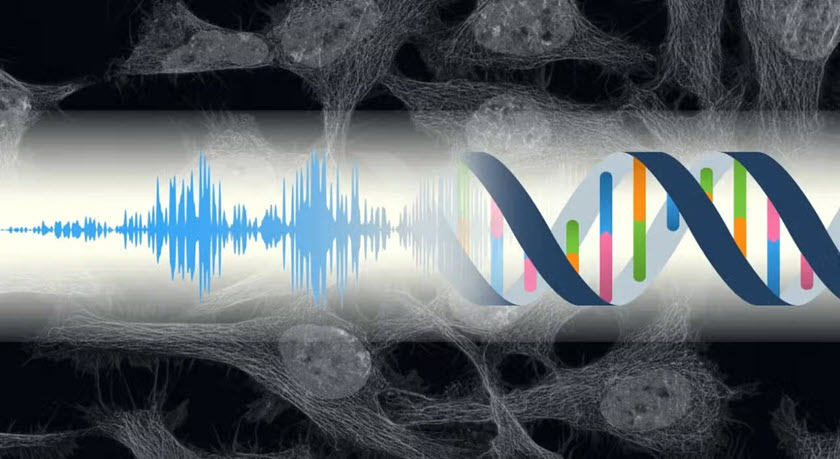
Featured Image: Cells react to sound waves like they do to chemicals, with new research showing gene-level responses and future medical potential. (CREDIT: KyotoU / Kumeta lab)
 Salubrious Sounds