Epigenetics is one way that scientists learn how the things around us and the choices we make change the way our genes work. We often think of genes as factors we have no control over. After all, we inherit them from our biological parents. And from the moment we enter the world, those genes determine so much about us — from our eye color to our risk for certain diseases. Genes feel set in stone and predetermined.
If you break down the word epigenetics, you get epi + genetics. “Epi” is Greek for “over, outside of, around.” “Genetics” refers to genes — the thousands of pieces of DNA that make you a unique person. So, when we talk about epigenetics, we’re talking about everything that’s around your genes.
What is the Epigenome?
Your epigenome is all of your genes plus everything that regulates how you use those genes. And your epigenome is dynamic. It changes over time. That can be both good and bad. It’s good in the sense that things like nutritious food, exercise and manageable stress can result in epigenetic changes that can promote health. But other factors like processed foods, smoking and lots of stress can cause epigenetic changes that can harm health.
What Can Change the Epigenome?
Your epigenome is shaped by countless forces, some of which begin exerting their influence before you’re even born. Here are some examples:
- The foods your biological mother ate while pregnant with you (pregnancy diet).
- Your biological mother’s overall health and well-being while pregnant.
- The nutrition you received as an infant and toddler.
- Trauma at a young age (adverse childhood experiences).
- Your learning experiences and interactions with adults as a young child.
- Exposure to toxins like diesel exhaust or cigarette smoke.
- Exposure to chemicals like plastics, BPA or heavy metals like lead or cadmium.
- Use of certain prescription medications.
- Use of substances like alcohol, tobacco and recreational drugs.
- The foods you eat as an adult.
- Your level of physical activity.
- The level of stress in your daily life.
- Your relationships and social interactions.
Can you positively influence your epigenome?
Yes. There’s no single roadmap for how to do it, but certain choices we make can support positive epigenetic changes and lower the risk of harmful changes. Eat nutritious foods, hydration, sleep, physical activity, limit alcohol and avoid tobacco products, manage stress, and sound therapy.
Epigenetic Healing Using Sound
Epigenetic healing using sound involves using specific sound frequencies and vibrations to potentially influence gene expression and promote healing within the body. Why? Because sound impacts the autonomic nervous system, brainwave patterns, and even pain perception, potentially leading to epigenetic changes.
How Sound Healing Works
Autonomic Nervous System: Your autonomic nervous system [†] is a part of your overall nervous system that controls the automatic functions of your body that you need to survive. These are processes you don’t think about and that your brain manages while you’re awake or asleep. Certain sound frequencies can stimulate the parasympathetic nervous system, promoting relaxation and the body’s natural healing processes.
Brainwave Entrainment: Brainwave entrainment, also known as neural or brainwave synchronization, is a technique that uses rhythmic stimuli like sound or light to encourage the brain to align its electrical activity with the frequency of the stimulus. This method aims to induce specific brainwave patterns associated with desired mental states, such as relaxation, focus, or creativity. Sound healing can induce changes in brainwave patterns, shifting from faster, alert beta waves to slower, more relaxed theta or delta waves, which are associated with deep relaxation and healing.
Pain Modulation: Pain modulation is the process of alterations in the pain signals along the transmission pathway of pain. Sound vibrations can stimulate nerve fibers, potentially affecting pain perception and leading to reduced pain and improved sleep.
Cellular Vibration: Cellular vibration refers to the oscillatory movements within and around cells, a phenomenon that is inherent to all living cells and plays a role in various biological processes. These vibrations, often described as molecular vibrations or mechanical vibrations, are not just random movements but are specific patterns that can be related to cell state and function. Sound healing may influence the vibration of cells within the body, potentially bringing them back into harmony and promoting optimal function.
Epigenetic Effects
Gene Expression: Gene expression is the process by which the information encoded in a gene is turned into a function. This mostly occurs via the transcription of RNA molecules that code for proteins or non-coding RNA molecules that serve other functions. Gene expression be thought of as an “on/off switch” to control when and where RNA molecules and proteins are made and as a “volume control” to determine how much of those products are made. Some studies suggest that sound can influence epigenetic markers, which are chemical modifications that affect how genes are expressed without altering the underlying DNA sequence.
Trauma Healing: The effects of trauma can follow you throughout your life, especially if you don’t seek help from a mental health professional. Here are some of the ways that trauma can disrupt your psychological and physical well-being, as well as your relationships. Sound healing, particularly sound baths, has been used with trauma patients, potentially helping to process and release emotional and physical trauma through non-verbal means.
Autism Spectrum Disorder: Autism spectrum disorder is a condition related to brain development that affects how people see others and socialize with them. This causes problems in communication and getting along with others socially. The condition also includes limited and repeated patterns of behavior. Research is exploring the use of sound frequencies as an epigenetic tool to address limiting symptoms associated with autism.
Examples of Sound Healing Techniques
- AO Scan: The AO Scan Technology program is a unique educational and wellness tool that provides users with non-invasive frequency-based feedback. It interacts with the body using subtle bio-frequencies and electromagnetic signals to help users increase awareness of their energetic patterns. By recognizing areas where energetic balance may be supported, individuals can make informed lifestyle and wellness decisions that align with their personal goals for harmony and self-awareness.
- Singing Bowls: These bowls produce a range of tones and vibrations that can induce relaxation and potentially shift brainwave patterns.
- Tuning Forks: Used to create specific frequencies that can be applied to the body to promote healing and balance.
- Gongs: The deep, resonant sounds of gongs can have a powerful effect on the body and mind, promoting relaxation and emotional release.
- Other instruments: Instruments like chimes, drums, and didgeridoos can also be used to create healing soundscapes.
Important Considerations
- Scientific Evidence: While research is promising, the field of sound healing and its epigenetic effects is still relatively new and requires further investigation.
- Individual Response: The effects of sound healing can vary from person to person, and it’s important to find a qualified practitioner and techniques that resonate with you.
- Holistic Approach: Sound healing is often used as a complementary therapy alongside other healing modalities, and it’s not a replacement for conventional medical treatment.
References
Brigati, Claudio, Maria Cristina Saccuman, Barbara Banelli, Angela Di Vinci, Ida Casciano, Luana Borzì, Alessandra Forlani, Giorgio Allemanni, and Massimo Romani. 2012. “Toward an Epigenetic View of Our Musical Mind.” Frontiers in Genetics. U.S. National Library of Medicine. https://pmc.ncbi.nlm.nih.gov/articles/PMC3268383/.
“‘Epigenetics Healing’ Meaning.” 2025. The Epigenetics Healing Center. Accessed July 23. https://drgoodbinder.com/blog/epigenetics-healing-meaning/.
One way to think about it is to imagine the metaphor of a circuit breaker. Think of your body as room covered with a billion circuit breakers; the majority of them are turned off or dormant, but a few of them are flipped. Now think of the factors we look at, such as your diet, sleep or organ function, as electrical currents. When enough of these currents misfire, they cause enough surge in the system to flip the circuits. When those switches flip, they turn on your chronic conditions.
Gallazzi, Marta, Marta Pizzolante, Elia Mario Biganzoli, and Valentina Bollati. 2024. “Wonder Symphony: Epigenetics and the Enchantment of the Arts.” Environmental Epigenetics. U.S. National Library of Medicine. February 1. https://pmc.ncbi.nlm.nih.gov/articles/PMC10944288/.
Gupta, Sanjana. 2023. “Sound Healing for Self-Care.” Verywell Mind. Verywell Mind. November 9. https://www.verywellmind.com/sound-healing-for-self-care-8384146.
Sound healing is an ancient wellness practice for healing, relaxation, and self-care. A sound healing session involves lying down in a cozy and comfortable setting, closing our eyes, and focusing on sounds made by music instruments. Sound vibrations have a pretty powerful effect on our minds and bodies. Research shows us that sound healing can slow down our brain waves and put our bodies in a very relaxed, dreamlike state. It may also be able to help with certain physical and mental health conditions.
Kandaswamy, Rajalakshmi. “Application of Sound Frequencies as an Epigenetic Tool in Reversing the Limiting Symptoms of Autism.” 2017. primescholars. Commentary – (2017) Volume 3, Issue 1. February 13. https://www.primescholars.com/articles/application-of-sound-frequencies-as-anepigenetic-tool-in-reversing-the-limitingsymptoms-of-autism-93409.html.
Looi, Valerie, Kate Gfeller, and Virginia Driscoll. 2012. “MUSIC APPRECIATION AND TRAINING FOR COCHLEAR IMPLANT RECIPIENTS: A REVIEW.” Seminars in Hearing. U.S. National Library of Medicine. November 1. https://pmc.ncbi.nlm.nih.gov/articles/PMC3583543/.
Niedelman, Dhyani Bella. “Sound Bathing as a Healing Modality.” 2022. September. https://scholarsarchive.byu.edu/cgi/viewcontent.cgi?article=1053&context=joni.
Rebecca. 2025. “The Power of Sound Therapy for Tinnitus Relief.” Astute Counseling & Wellness. Accessed July 23. https://astutecounseling.com/the-power-of-sound-therapy-for-tinnitus-relief/.
Sound therapy is a non-invasive and drug-free approach that uses sound to relieve tinnitus symptoms. Sound therapy aims to reduce the perception of tinnitus by masking, habituating, or neuromodulating the sound. The therapy can be delivered through various methods, including wearable devices, smartphone apps, and sound machines.
Seetharaman, Rajmohan, Sanika Avhad and Jitesh Rane. “Exploring the Healing Power of Singing Bowls: An Overview of Key Findings and Potential Benefits.” 2024. EXPLORE. Volume 20, Issue 1, January–February 2024, Pages 39-43. https://www.sciencedirect.com/science/article/abs/pii/S1550830723001660.
Seo, and Kalu Paula. 2025. “The Power of Sound Healing: Transforming Emotions and Restoring Balance.” Oceanic Yoga International. July 21. https://www.oceanicyoga.com/the-power-of-sound-healing-transforming-emotions-and-restoring-balance/.
The theory on which sound healing is based is that all things in the universe and, therefore, our bodies are in a state of vibration. If this vibration is harmonious, there is health and balance; if not, disease in the form of physical or emotional discomfort occurs. Sound healing realigns the body with harmonious vibrations through the application of certain forms of sound, such as music, vocal tones, and instrumental applications.
“SOUND HEALING.” 2024. Empowered Therapeutics. https://empoweredtherapeutics.org/sound-healing/.
“Sound Healing.” 2024. South Coast Behavioral Health. February 29. https://www.scbh.com/therapies/sound-healing/.
“Sound Healing for Surgery & Recovery: Dr. Ginger Xu in San Francisco.” 2025. Ethos Plastic Surgery | Ginger Xu, MD. March 27. https://www.gingerxumd.com/post-surgery-sound-healing/.
“Sound Healing Therapy: Benefits, Techniques, and How It Works.” 2025. Vivre Experiences (Voila Joie). January 11. https://vivreexperiences.com/blogs/health-wellness/sound-healing-therapy-benefits-techniques-and-how-it-works.
Sound healing therapy uses sound vibrations to improve mental, emotional, and physical health. It is different from traditional music therapy, which involves listening to or playing music. Sound healing focuses on specific frequencies and vibrations that resonate with the body. It is like a “tune-up” for your mind and body. Just like musical instruments need to be in harmony with each other to create beautiful sounds, your body needs its energy in balance. Practitioners use sound frequencies to help restore this balance, promoting relaxation and healing.
“Sound Therapy And Sound Healing Sessions Complete Course.” 2025. udemy. Accessed July 23. https://www.udemy.com/course/sound-therapy-and-sound-healing-complete-course/.
Sound Therapy is a holistic healing practice that uses sound vibrations to improve mental, emotional, and physical well-being. It involves the use of various sound-producing instruments such as tuning forks, singing bowls, gongs, and even the human voice to create therapeutic sounds. The basic idea behind Sound Therapy is that sound can influence the body’s energy fields, leading to a state of harmony and balance. Sound Therapy works on the principle that different frequencies of sound can affect the body’s cells and organs. When these sounds are played, they can help align and balance the body’s energy centers, also known as chakras. For instance, certain frequencies are believed to help relieve stress, reduce pain, and promote deep relaxation. During a Sound Therapy session, practitioners often use specific sound patterns to target particular areas of concern, helping to restore a sense of overall well-being. One of the ways Sound Therapy works is by influencing brainwave activity. Our brains operate at different frequencies depending on our state of consciousness, such as being awake, relaxed, or asleep. Sound Therapy can help entrain the brain to different states by using rhythms and frequencies that align with desired brainwave patterns. For example, certain sounds can help induce a state of deep relaxation or even improve focus and concentration.
“The Power Of Self Healing Through Sound.” 2024. Sound Healing Academy. November 21. https://www.academyofsoundhealing.com/blog/awaken-your-inner-healer-the-power-of-self-healing-through-sound.
The human body is a remarkable system capable of maintaining balance, or homeostasis, through its complex interactions between organs, cells, and biochemical processes. When everything works harmoniously, the body has the potential to regulate itself, repair tissues, fight off infections, and maintain mental clarity. This natural healing process relies on various systems, such as the immune, nervous, and cardiovascular systems, working together seamlessly. However, modern-day stressors such as long working hours, unhealthy eating habits, pollution, and emotional strain can interfere with this natural balance. Chronic stress, in particular, affects the body’s ability to heal, often leading to physical, emotional, and psychological ailments. When balance is disrupted, the body struggles to repair and regenerate efficiently. This is where self healing practices like sound healing come into play to help restore equilibrium!
“The Role of Epigenetics in Energy Healing.” 2024. blog.janellrae.com. December 27. https://blog.janellrae.com/post/the-role-of-epigenetics-in-energy-healing.
Wei, Marlynn. “The Healing Power of Sound as Meditation.” 2024. Psychology Today. Sussex Publishers. January 16. https://www.psychologytoday.com/us/blog/urban-survival/201907/the-healing-power-of-sound-as-meditation.
“What Is Epigenetics?” 2025. Cleveland Clinic. July 3. https://my.clevelandclinic.org/health/articles/epigenetics.
Autonomic Nervous System
What is the autonomic nervous system?
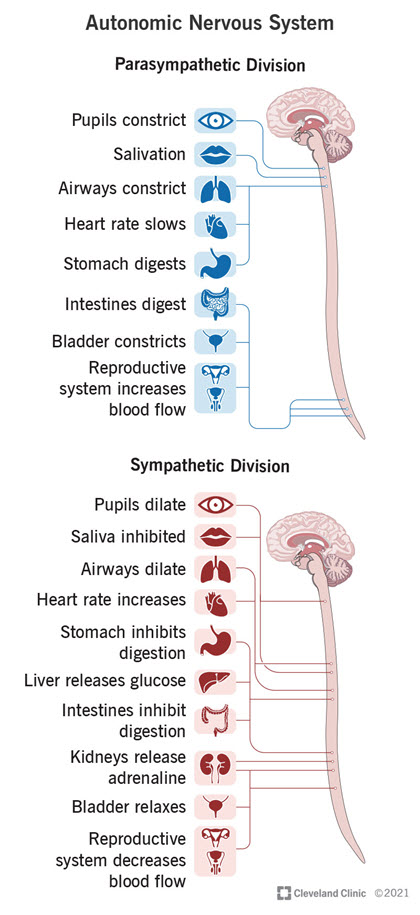
Your autonomic nervous system is a part of your overall nervous system that controls the automatic functions of your body that you need to survive. These are processes you don’t think about and that your brain manages while you’re awake or asleep.
Where does the autonomic nervous system fit in the overall structure of the nervous system?
Your overall nervous system includes two main subsystems:
- Central nervous system: This includes your brain (your retina and optic nerve in your eyes are considered part of your brain, structure-wise) and spinal cord.
- Peripheral nervous system: This includes every part of your nervous system that isn’t your brain and spinal cord.
Your peripheral nervous system also has two subsystems:
- Somatic nervous system: This includes muscles you can control, plus all the nerves throughout your body that carry information from your senses. That sensory information includes sound, smell, taste and touch. Vision doesn’t fall under this because the parts of your eyes that manage your sight are part of your brain.
- Autonomic nervous system: This is the part of your nervous system that connects your brain to most of your internal organs.
What does the autonomic nervous system do?
Your autonomic nervous system breaks down into three divisions, each with its own job:
- Sympathetic nervous system: This system activates body processes that help you in times of need, especially times of stress or danger. This system is responsible for your body’s “fight-or-flight” response.
- Parasympathetic nervous system: This part of your autonomic nervous system does the opposite of your sympathetic nervous system. This system is responsible for the “rest-and-digest” body processes.
- Enteric nervous system: This part of your autonomic nervous system manages how your body digests food.
“Autonomic Nervous System: What It Is, Function & Disorders.” 2025. Cleveland Clinic. April 1. https://my.clevelandclinic.org/health/body/23273-autonomic-nervous-system.
The featured image on this page is from the Adobe Stock website.
 Salubrious Sounds